This is my guy. We saw old Oswaldo's home in Quito, as well as the museum he set up that houses these beautiful pieces. Of course I couldn't really understand most of what was said on the "tour," and nobody *cough*Anita*cough* helped translate . Dude was much involved in progressive movements, much loved, and worked towards a better world through his interpretation and representation of physical and esthetic beauty (aka mostly pain and sorrow). Hasta la victoria siempre, manana hay misa para los sordos.
Thursday, April 9, 2009
photo 11
This is my guy. We saw old Oswaldo's home in Quito, as well as the museum he set up that houses these beautiful pieces. Of course I couldn't really understand most of what was said on the "tour," and nobody *cough*Anita*cough* helped translate . Dude was much involved in progressive movements, much loved, and worked towards a better world through his interpretation and representation of physical and esthetic beauty (aka mostly pain and sorrow). Hasta la victoria siempre, manana hay misa para los sordos.
Tuesday, February 3, 2009
photo 10, the return
What was once a clever self-motivational technique to take more pictures has become a lazy excuse to re-trot out one of my favorite passages from one of my favorite books on one of my favorite topics. (I had no idea I had previously excerpted this very same passage in photo 4, but it's just so good, and judging by the paucity of comments, it's not going to kill anyone to have to read it again, and maybe the more relevant picture will help). Here's absolutely brilliant stuff from Malcom Lowry's much-referenced-by-me Under the Volcano:
And at the next moment, though not before there had passed between himself and the doctor a barely perceptible exchange of signals, a tiny symbolic mouthward flick of the wrist on the Consul's side as he glanced up at his bungalow, and upon Vigil's a slight flapping movement of the arms extended apparently in the act of stretching, which meant (in the obscure language known only to major adepts in the Great Brotherhood of Alcohol), "Come up and have a spot when you've finished," "I shouldn't, for if I do I shall be 'flying,' but on second thoughts perhaps I will" - it seemed he was back drinking from his bottle of tequila. And, the moment after, that he was drifting slowly and powerfully through the sunlight back toward the bungalow itself. Accompanied by Mr. Quincey's cat, who was following an insect of some sort along his path, the Consul floated in an amber glow. Beyond the house, where now the problems awaiting him seemed already on the point of energetic solution, the day before him stretched out like an illimitable rolling wonderful desert in which one was going, though in a delightful way, to be lost: lost, but not so completley he would be unable to find the few necessary water-holes, or the scattered tequila oases where witty legionnaires of damnation who couldn't understand a word he said, would waive him on, replenished, into that glorious Parian wilderness where man never went thirsty, and where now he was drawn on beautifully by the dissolving mirages past the skeletons like frozen wire and the wandering dreaming lions towards ineluctable personal disaster, always in a delightful way of course; the disaster might even be found at the end to contain a certain element of triumph.
Friday, November 28, 2008
Monday, November 3, 2008
Thursday, October 16, 2008
photo 7 for real
Tuesday, September 16, 2008
photo 5
Tuesday, September 2, 2008
photo 4
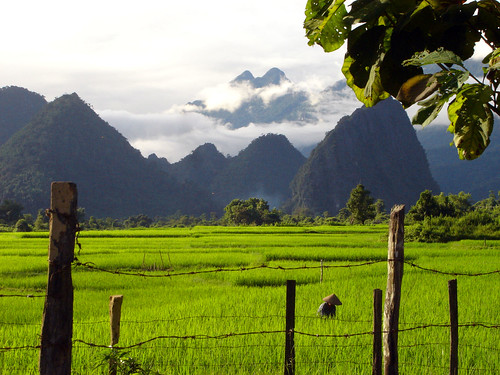
a solitary laborer in the beautiful countryside outside vang vien, laos. the mountain peering out from the clouds at least arguably resembles a volcano, providing just the scintilla of excuse I need to quote from under the volcano.
And at the next moment, though not before there passed between himself and the doctor a barely perceptible exchange of signals, a tiny symbolic mouthward flick of the wrist on the Consul's side as he glanced up at his bungalow, and upon Vigil's a slight flapping movement of the arms extended apparently in the act of stretching, which meant (in the obscure language known only to major adepts in the Great Brotherhood of Alcohol), "Come up and have a spot when you've finished," "I shouldn't for if I do i shall be 'flying,' but on second thoughts perhaps I will" - it seemed he was back drinking from his bottle of tequila. And, the moment after, that he was drifting slowly and powerfully through the sunlight back toward the bungalow itself. Accompanied by Mr. Quincey's cat, who was following an insect of some sort along his path, the Consul floated in an amber glow. Beyond the house, where now the problems awaiting him seemed already on the point of energetic solution, the day before him stretched out like illimitable rolling wonderful desert in which one was going, though in a delightful way, to be lost: lost, but not so completely he would be unable to find the few necessary waterholes, or the scattered tequila oases where witty legionnaires of damnation who couldn't understand a word he said, would wave him on, replenished, into that glorious Parian wilderness where man never went thirsty, and where now he was drawn on beautifully by the dissolving mirages past the skeletons like frozen wire and the wandering dreaming lions towards ineluctable personal disaster, always in a delightful way of course; the disaster might even be found at the end to contain a certain element of triumph.
Friday, August 22, 2008
foto de la semana 3
Thursday, August 14, 2008
photo of the week 2

Friday, August 8, 2008
photo of the week 1
Wednesday, May 21, 2008
Wednesday, March 26, 2008
via violenta viven
Monday, March 10, 2008
under the volcano
The water still trickling into the pool - God, how deadeningly slowly - filled the silence between them... There was something else; the Consul imagined he still heard the music of the ball, which must have long since ceased, so that this silence was prevaded as with a stale thudding of drums. Pariah: that meant drums too. Parian. It was doubtless the almost tactile absence of the music however, that made it so peculiar the trees should be apparently shaking to it, an illusion investing not only the garden but the plains beyond, the whole scene before his eyes, with horror, the horror of an intolerable unreality. This must be not unlike, he told himself, what some insane person suffers at those moments when, sitting benignly in the asylum ground, madness suddenly ceases to be a refuge and becomes incarnate in the shattering sky and all his surroundings in the presence of which reason, already struck dumb, can only bow the head. Does the madman find solace at such moments, as his thought like cannon-balls crash through his brain, in the equisite beauty of the madhouse garden or of the neighboring hills beyond the terrible chimney? Hardly, the Consul felt. As for this particular beauty he knew it dead as his marriage and as willfully slaughtered. The sun shining brilliantly now on all the world before him, its rays picking out the timberline of Popocatepetl as its summit like a gigantic surfacing whale shouldered out of the clouds again, all this could not lift his spirit. The sunlight could not share his burden of conscience, of sourceless sorrow. It did not know him.
Thursday, March 6, 2008
the wave-particle-like duality of art
Is it inconsistent to assert that the internalization of art is a subjective experience, while nevertheless admitting that there must be a set of objective criteria with which to evaluate it? Another illustration: the following pictures were both taken at Angkor Wat, the first by myself and the second by someone else.


I think it would be difficult to argue that my picture is not objectively worse than the second. Though the pictures are from opposite ends of the same structure, the intentions of each basically line up: awesome ruins, reflection in moat splits the frame, solemnly blue sky interrupted by a divine-like break of the clouds centered above the structure, etc. Going against my version is a lesser quality resolution and damper colors (my wimpy zoom and amateur digital camera is no match for whatever pro-digital-slr-whatever the other photog got to use). Also, the other shot is perfectly and evenly framed, whereas I would have loved to cut off mine on the right just after the tall structures in the background and before the appearance of the branches on the left. And of course my beautiful photo is sullied by the presence of ugly, ugly tourists walking the bridge and climbing the steps. The off-angle view in my work is actually, I think, more interesting and provides a depth you don’t get in the professional, straight on approach. But nevertheless, I think it’s too little, too late, mine is probably inferior. Beauty is in the eye of the beholder, yes, but doesn’t intellectual honesty require that we declare a winner when there is one?
Another more salient example comes from the recent Academy Awards. Now, yes everyone knows, award shows are stupid, and the Oscars are particularly dumb, but awarding Best Picture to the Cohen Brothers’ No Country for Old Men over P.T. Anderson’s There Will Be Blood is especially egregious and cannot be justified on any objective grounds for evaluating art. The latter is clearly the more ambitious project, both thematically, as an allegory for this country’s dual strains of unbridled capitalism and fanatical religiousness, and how adherence to either will lead you to ruin, as well as cinematically, as Anderson uses a variety of long, drawn out shots, steady cams, moving cams, an insane score by Johnny Greenwood, and coaxes performances from Daniel Lewis and Paul Dano that each range from frightening brutality to pathetic vulnerability and everywhere in between. No Country is a great little picture, but it does not profess or try to be anything nearly as magnificent. It’s a nice little thriller, chase/stalker flick with a likeable protagonist you root for and a psychopathic weirdo you are terrified of, with meandering and barely sufferable interludes featuring a retiring old-timer cop who pontificates on what it all means. Good stuff. But there is no wild range of emotion, no novel shots of people scurrying towards and then away from an exploding oil derrick, no interesting score, no descent into the abyss, and no social commentary. There is much too much happening in Blood to digest and appreciate on one viewing, one needs to watch it again to get the subtleties, the interplay with the music, the information contained in the numerous dialogue-less shots. I can’t imagine anyone needing to see No County again; once you know what happens, what else is there? It was almost surely its social commentary that sealed Blood's fate. It brings to mind Julie Christie’s remark on the Oscar winning German film, The Lives of Others: “I’m not sure I can bear to see a film they gave the Oscar to, that tells you what awful people Communists are.” Amen, sister.
So how can art be at the same time a subjective experience that cannot be evaluated on anything more than a personal basis, yet also a creation that exists in the context of many other creations who all succeed and fail to varying degrees on the basis of objective criteria? In much the same way that light acts simultaneously as a wave and a particle, no one knows.
What we’ve learned:
1) Producing art is fun. Talking about art, less so.
2) I need a better digital camera.
3) There Will Be Blood is very good.
4) Julie Christie is awesome.
Friday, February 15, 2008
pasha's log: day 13