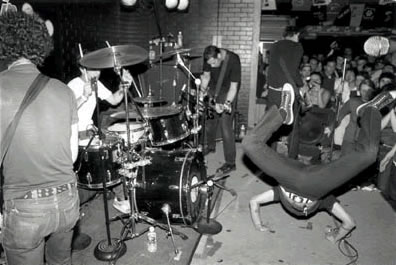
I made a film. [Hold
for applause and/or wanking motion] It is
difficult to pinpoint a specific motivation beyond simply wanting to, an
admittedly broad enough class in the taxonomy of desires to cover genera from
“Iono” all the way to “why not.” Making
the film was the means to an end which was making a film. Which is all really just to say: I didn’t have any grand designs re what to do
once/if the film was completed. And so
it remains. The problem with putting
things off until the times come is that ultimately the time will come:
Notwithstanding a long, sad list of mistakes and regrets over
limitations in equipment, time, experience, ability, and most everything else save
perhaps moxie, and aided by enough distance to reflect on what was done
properly and enough alcohol to forget the rest, I am fairly happy with the
result. A masterpiece it is not, but
there’s a lot on screen that I’m really proud of (blah blah blah), and it’s a
pride dwarfed by (blah) the amount of fun (blah) I had in making it (blah). Banal clichés aside, once the smile of smug
self-satisfaction relaxed into its usual scowl and the memories of laughs dimmed
to vague recollections of something happening to someone somewhere, what was I
left with? Seventeen minutes of playful
whimsy viewed by no more than a few dozen friends (none of whom are my
otherwise amazing and supportive and, apparently, extremely busy wife), a handful
of festival rejections (another one happily came in while writing this!), and a
lingering niggle of chagrin seem to be the more notable contents of my Me and I
gift bag. The unfulfilled wish for the film to reach a
wider, praise-lavishing, acolyte-turning audience not only sits as an embarrassingly
vain disappointment unto itself but also compromises what I hoped would and
should be a singularly satisfying accomplishment. My thoughts regarding the experience of
making the film, of real achievement, are now intertwined with unpleasant feelings
of unrequited longing, unfulfilled promise, and, weirdly, paradise lost. I have cast a
pall on myself.
Assuming the drive to create was as pure as I want to
believe, why must it now be sullied by a demand for attention often seen in
your garden-variety mental patient? Part
of it is functional in that some form of positive feedback would have facilitated
or at least made making another film more likely, if not via wheel greasing
of future cast and crew then by validating the push to carry on, to avoid filmmaking
being added to the list of creative larks that shriveled malnourished and unattended to on the vine of my aesthetic life (see,
e.g., my discarded standup career). But there’s
another part of it that reeks of pure egoism. It’s
probably normal, but I’m not sure it’s helpful.
I did something I think is pretty great.
Why can’t that be enough? And
will it ever be? Will the drive to
create lead me to do something even better, or will the fear and expectation of
recognitional failure prevent me from even trying?
These are important questions, and the answers are elusive.
As the painful, unrelenting dance of tetchy robins tussling over the prized, worm-filled dirt plays out under a teasing, thawing sun, I remember it's that time of the new year to look back at the old year, to navel-gaze so deeply so as to invite whatever awed derision or jeering nonplus or, worse, bland indifference may come.
And with that, this:
I guess the "important" take-away "points" here are: I, for the first time in my long, distinguished career of doing this nonsense, actually hit my stated goals. The number crunching, tracking, and planning took on a fanatical, religious-like importance this year, particularly in the second half after returning from India in June. It's interesting that in around early Fall I felt as good physically as I'd ever felt before (and was playing the best hockey of my life (ed. note: which is still pretty terrible hockey)), but after a sloppy holiday season followed by some ol' timey visitors and the bacchanalia that ensued, followed by a busy work period, followed by a smarch seasonal and possibly existential malaise, I'm basically now in as poor a shape as I've been in in a long while. Huzzah. Also, note the existence of the classic inverse or mirror image relationship between the two lines, which we've seen before but perhaps never more beautifully than the stretch from July to December here. And for what it's worth, the inside/outside drinking ratio was 36.6%/63.4%. I'm not sure what conclusions should be drawn from that ratio (perhaps that I need to get out more? Less?), but it is consistent with historic levels.
It's interesting to note that while my average drinks per day was only about 3.1, the standard deviation was actually 3.2, so I wasn't merely having an extra glass of Dolcetto before dessert - I was either having the whole bottle, with a couple of Makers chasers, or tee-totaling. I think for now I'd prefer the higher standard dev. with a lower average than the reverse, although I could certainly see changing views on that as I continue to get older. This year's already off to a very rocky start so who know's where the workout number will end up. With the baby coming, I'd like to get the drinks to under 20, and I imagine the pre- and post-August splits will be fairly dramatic.
My vanity project cloaked as data accumulation-cum-self-improvement has continued unabated. The results of 2011, not to be thought of as distinct from the experience of 2011, were disappointing.
You may recall my goals of 21 and 4.75 drinks and work-outs per week, respectively. Well, I got halfway there on the boozing front, making it down from 30 to just over 25. Though I didn't do any in-year tabulations, I sort of knew I was going to miss that mark while in the midst of a largely, generally crappy annum, but alas, not only did I not hit the exercising target, and not only did I go backwards by about 5%, but I was blissfully unaware of and completely surprised by it. I guess alcohol does give you an inflated sense of self. And a distorted view of the present.
The main wrinkle I added for 2011 was classifying each drink as being In - in the apartment alone or, e.g., at The Pub at lunch alone - or Out - socially, with other people drinking. For whatever little elucidation it's worth, I was at 34% In and 66% Out for the season. I have no idea what to take from that, but there you go.
2012 Goals - 20.5 and 5.0. And the end of US hegemony.
The second half of the fall season went much like the first: a certain amount of personal success (beaucoup is an amount) and a certain amount of team dominance (zero is another amount). Despite mostly underachieving for the first 5/8's of the season, we were nevertheless in a decent position to make the playoffs before dropping four straight down the stretch, with each a very winnable game, and were forced to play out, and win out, the string. Unlike the team, I was mostly consistently brilliant throughout. At least as far as the boxcars go:
Nearly a goal per game, 1.6 points per game, and a fairly ridiculous 23.6% shooting percentage, On the one hand I'm kind of ecstatically pleased with my personal season, but I'm also worried that some shooting% regression plus fewer good bounces plus decreased ice time plus the loss of our captain and spiritual leader (the stats guys love the last seven words) plus a non-insignificant amount of roster turnover plus a ridiculous trial and trial prep throughout the bulk of the season could all lead to a disastrous '11 spring. But I'm also worried that something terrifyingly horrible will happen to Anita and Pasha on their totally normal walk around our neighborhood right now. So maybe it's just me.
That at least some of the talk of these exploits is with tongue firmly inside of cheek is, I hope, clear; if not, I'll remind myself and everyone else that notwithstanding the ceremonial li'l fist pumps after the denting of the twine - THE greatest physical joy known to man (apologies to both my wife and my meth dealer) - I did most certainly give up a lot the other way: turnovers inside the zone, missed assignments that lead to goals, lost battles in the corners, etc. These all continued to rear their ugly heads, and while I'd argue it was all to a lesser extent than ever before, I am certainly no Martin Hanzal or Frans Neilsen just yet. Rather, and this is somewhat interesting, I think a ridiculous 9 of my 13 goals came on wrist shots from outside the circles. I think that makes me of the Michael Ryder / Joffrey Lupul mold of one-dimensional, one skill-set players. And with that, what started out as a boast post ends up a suicide note.
But I won't end on such a dour note. For my friends, fans, and most importantly for myself, when I'm too long in the tooth to do any of these things or even remember them, here are my top five favorite plays of the season:
5) GM1 v. Hudson Hawks, Sep. 12, 2010: As much as I kind of don't like him these days, my love of hockey started exclusively with Wayne Gretzky. Perhaps his most signature move, especially over the period that I watched him, was him setting up behind the net and passing it out in front for a tap in. I capped off a 5 point opening night with that very play, feeding it to Geno for the last goal in an enormously fun win.
4) GM15 v. Irish Times, Jan. 9, 2011: Virtually eliminated from the playoffs, we beat the eventual champion. I scored what ended up being the game winner on a very unspectacular but completely typical goal: took a short pass at center ice, walked into the zone, dmen did not step up, waited, waited, saw room high blocker, wristed it basically exactly where I wanted from probably just inside the top of the circle. No fuss, no muss.
3) GM8 v. Impact, Nov. 10, 2010: Late in a tightly contested game against the eventual runner up, I collected the puck behind the net, took a step out in front, waited for the goalie to go down or open up some space to shoot, waited, waited... saw our dman (Hambly) jumping into the slot from the point, put it right on his stick, and he buried it. Probably my highest hockey IQ play all year.
2) GM10 v. Brother Jimmy's, Dec. 10, 2010: Had two goals in a 7-3 romp, but the second was kind of a beauty. Shorthanded, dman (Joel) won a battle in our own zone, skated up the right side, I took off down the middle, he threaded it perfectly, collected it in stride at the blue line, split the two d, went in alone and wristed it short side. It was probably the fastest I skated all season and there was no doubt that I was going to score. Magical feeling of exhilaration.
1) GM14 v. Homer's Heroes, Jan. 2, 2011: The structure of the goal itself - took a pass at the red line, made one move at the blue line to beat a defenseman (Karel), walked in down my off wing and beat the goalie up high, far corner from between the dot and top of the circle - wasn't that unusual or spectacular; rather, it was special because it was against the best goalie in the league, a goalie that is very difficult to beat, and he had come well out of the crease and gave me almost nothing to shoot at. There were times during the season where I felt like I could hit quarters strategically placed in the net, and this goal was the ultimate expression of that feeling - ripped off the post and in, a glorious sound and sight.
To further my heretofore narrowly manifested data accumulation penchant, I did the unthinkable, most likely totally useless, and even more likely hardcore douchey. That's right, I started tracking and quantifying my workouts. It was mostly an attempt to shame me into working out more thereby contributing to my record setting hockey season, but it was also largely a way to spend more time looking at and writing things in my JRT calendar. Amusing but not joking. In any case, the process wasn't all that quantitative. I essentially made one of four basic notations to correspond to a workout: an up arrow (meaning I lifted upper body, usually combined with some cardiovascular work, usually either short distance running or interval training bike work), a down arrow (meaning lower body lifting combined with the same CV caveats), a BS (meaning Bluestreak, which is a brutally difficult but awesome hockey-specific workout involving the dreaded skating treadmill), or an H (meaning that I played hockey). Sometimes I'd also threw on an R (meaning I just ran) or an S (which means I did my pseudo-ashtanga stretches usually with some core work thrown in). This all sounds more intense than it really was; those who know me will take comfort in knowing that I half-assed my way through most of all this. Except for the Bluestreak sessions, those are usually insane.
About halfway into the year, I started actually trying to quantify the level of intensity of each workout, assigning a value of anywhere from .5 top 1.25 with a lifting session usually getting a 1.0, a BS session getting a 1.25, and H getting a .75 or 1.0 depending on how much and how hard I played and if I did a stretching/core session before or after. Yawn yawn, and to anyone who's still reading at this point: marry me. To make things more interesting and/or depressing (depending on if you're a future AA counselor or a current parent), I started counting my alcoholic drinks sometime towards the end of June. Pretty simple, each drink counted as, wait for it, one drink. Whereas I used to pour myself whiskey at home without regard to volume, I tried to pour myself glasses that corresponded to one "drink," and I did my best to count 'em all up (though after around 10 in a night it could get a bit hazy). Here are the results in graph form:
(Click to enlarge)
The results are fairly straightforward. The inverse relationship between my alcohol intake and exercise output seems pretty clear and strong, which is in no way surprising. I averaged around four and a quarter "workouts" per week, which is actually not all that disappointing. 30 drinks a week, however, is a bit of a horrifying embarrassment. In my defense, there were a disproportionate number of big one-time only drinking events this past year that probably unfairly pushed that average a bit on the high side, e.g. the bachelor party, wedding, honeymoon, and that winter solstice eclipse thing that just happened. My goal for next year is to cut down to 21 drinks per week, a 30% reduction, which is certainly significant, but one that I am going to go ahead and publicly commit to making. I'd also like to get up to around 4.75 workouts per week as well. Don't worry ye faithful few, you won't have to wait a whole year in suspense, I'll give you guys a mid-year update on all of this sometime after June. Spoiler alert: I am already perhaps irrevocably off pace on both counts just two and a half weeks in. Damn you, cold and miserable winter.
NYU-HJD (so named because when the team was first formed it was made up of mostly orthopedic surgeons at the Hospital of Joint Diseases, from whom we also received some funding; of course the docs and dollars are all gone yet the name remains, indicating the mixture of loyalty, laziness, and lack of creativity that has plagued the team on and off the ice since its inception) has reached the midpoint of another season. A ragtag group of lovable losers, never weres dramatically outnumbering has beens, the current incarnation is probably my favorite HJD composition in the 6 years(!) it's been active at Chelsea Piers. "Favorite" being more an evaluation of team personality than team success, as our 3-5 record doesn't do justice to a league worst goal differential that is -3 red lights per game (there is no red light, obviously). Our division houses a very mixed bag of players who basically can't skate, some who grew up playing competitively and are actually good, and everything in between. Goal differential aside, I think our team has the ability to do some damage in the playoffs. If we get some puck luck. And if we make the playoffs first.
As a devoted empiricist and avowed chronicler of the human condition (particularly mine), I try to diligently and accurately record my box car stats every season. It helps set goals and facilitates sober evaluative reflection and blah blah blah, I'm a sad, pathetic person looking for a reason to stay alive... here we go with my season thus far:
Few notes: 1) This division's teams' names are atrocious and speak volumes about the quality of hockey. 2) My realistic goal for the season was to get 1.5 PPG, and my ideal if-everything-breaks-right goal was 2.0 PPG. I'm currently at 1.57, so I'm not too displeased (though my shooting% is 24 which is a tad above my historical rate of 16-20% so I can expect a little regression there... fuck sabermetrics). 3) The DNP was due to my wedding and I think the goose eggs around it can be reasonably attributed to wedding-anxiety and -exhaustion, respectively (I feel like I'm going to be blaming a lot of things on that wedding over the next 50 years), so I'm cautiously expecting a bigger 2nd half performance (individually, the team will continue to be terrible, I imagine). 4) I am the kind of player that has to be top-6 or I'm basically useless. With a Bob Kudelski-type release, I'm decent with the puck but awful without it; I have no idea what I'm doing in my own end; and I'm one of those players that, when the puck is tied up along the wall, I'm firmly on the wrong side of it, waiting, hovering, hoping it randomly squirts out to me. Think Phil Kessel meets Alexander Selivanov. That said, I've scored or assisted on a Lemieux-esque 58% of my team's goals (in the games I've played). Speaking of Super Mario:
I think the numbers are pretty clear, but I'll spell it out for you just in case: I will go down as the greatest D5 hockey player in Chelsea Piers history. And then I will own one of the teams and get a local government to subsidize my private money-making arena and grow a beard that looks ridiculous and no one will ever criticize me for anything. There it is.
Also, this Norwegian kid is ridiculously sweet and he would be the best player on our team. And he's ten years old. Sick.
I don't think anyone expected that. Some of the signs were there, though:
I remember Dan Bylsma well from when he joined the LA Kings toward the end of Gretzky's career there. Gretzky, or more accurately his arrival to LA and its facsimile of a hockey team, changed my life irrevocably. He was my Dominique Wilkins replacement (which is not said with an iota of irony or rue). My DNA was filled with more hockey-receptors than the basketball- kind, so this had retardedly significant ramifications. I lived and died with the LA Kings for a few years, until it was mostly dying, and my once mighty idol - that spring of 93 was something though, eh - was schleppnig through whatever detritus a penny-foolish, pound-foolish management team threw against the wall and hoped stuck. Long story short, it got bad towards the end, with the Kings calling up career minor leaguer Danny Bylsma, a good penalty killer and hard worker, to fill one of the many holes in their lineup (John Slaney was one of the few kids they got right... and then promptly gave up on (though to be fair, several teams did the same, including the Caps eventually - beauty player though)), and I remeber one shift in particular when Gretzky broke in 2-on-1, a rare event at this point in his career, and threaded a pass between the skates of Bylsma (can you imagine what that poor bastard who had never scored 20 goals in professional hockey was thinking being in the NHfuckingL breaking in alone with Wayne fucking Gretzy), and Bylsma wiffed ingloriously. And fell down in the process. Another chance wasted in a season of wasted chances and poor results. I remember cursing Bylsma at the time - how could he fuck up a pass from my Gretz - but shortly thereafter feeling bad for him, knowing the whole time it wasn't really his fault and that the team, and Gretz to a certain extent, sucked.
I didn't know what to think when Bylsma got the job in Pittsburgh. I thought Therien was a great coach, for sure, but one who had probably seen his shelf-life expire at that point with that team (that happens frequently with miserable bastards, French-Canadians even sooner I think). But oh my what a job he's done. I don't think the Penguins personnel is any better - no matter how you consider it - than the Capitals (in fact, I think it's worse). But they certainly are a better team - and play better as one, if that's a distinction - than the Crapitals (no sic.) - and it's not particularly close. Don't let the 7 games and 3 OT's fool you. They basically dominated possession and position throughout. And I think alot of that comes from Bylsma. And from Therien. Ol' Michel instilled in them a strong defensive responsibility/acumen, the competing in all three zones, the X's and O's of where to be without the puck. That kind of foundation takes time, hard work, and a whole mess of unpleasantness (a bunch of things the Boudreau-led Caps never achieved/endured). Bylsma brought a voice and face of someone the team didn't view as an unbearable asshole, which is important. He opened things up a bit, let the team skate forward without the puck, made the game a little more fun again. And he's a smart fucking guy. Everything I heard him say during the Caps series made me think, "this guy 1) actually knows what he's talking about, and 2) and can say it in an interesting way." Which is unbelievably rare for a hockey coach, let alone a human.
I've traditionally been a big Bourdreau fan, to the extent he's got that hard-to-hate-on portly shape and fun-loving, golly-gee-how'd-i-end-up-here demeanor. He isn't afraid to try to be funny or even silly, the players clearly love him, and he doesn't try to suffocate or hinder skill. Folky, gregarious, loyal; a guy that if you don't like the rigidity and absence of personality of pro sports, it's hard to root against. That said, he's probably the worst possible coach for that group of guys right now. He gives them way too much rope, allows them to play as loosey-goosey as any team the NHL has seen since NHL'ers stopped smoking Camel lights on game days. OV, Semin, Green are all given waaay too much automony: they overstay shifts, don't really have to be hyper vigilant away from the puck, and have not been sufficiently admonished into making safe plays at all times in all zones. It's a curse of having an excess of skill, but it's one Boudreau had to address if he wanted this team to be great rather than good. In the end, they weren't very good. Too loosey-goosey, assholes.
To a certain extent, there is a personnel problem, as the Pens have a beautiful and brilliant shutdown tandem of Hal Gill and Rob Scuderi that combined make less money than the last top D pair of the Hartford Whalers (Zarley Zalapski and Glen Wesley?). The Caps should, in theory, be able to at least match that, or at least frustrate the hell out of Crosby and his pathetic sidekicks, with Morrisson and Poti, but different roles, different results (having Crosby and Malkin on different lines complicates things, of course) (Jeff Schultz proves useless yet again. Boy I wish we kept Johnny Oduya instead).
The better team won (empahsis on team, not collection of players). And honestly, I'm a lot happier with it that way. Now Detroit needs to defeat the most evil collection of hockey players of my lifetime, and I'll be able to live with the stupid Earth continuing to keep fucking spinning.
Perhaps it’s not revelatory to suggest that the medium can significantly affect the relationship with the underlying content, but it’s at least noteworthy that the mp3 has nearly extinguished my ability to recall or even recognize the names of the songs I like. It’s not so much as the mp3 itself – all compressed with the harrowing cries of audiophiles in the distance, “that high-hat just doesn’t have the clarity!” – as it is the absence of the CD booklet; whereas years before I would eagerly devour those little doggies, special attention paid primarily to the lyrics, secondarily to nuggets of publishing registrations and studio locations, as I listened along, I now find myself surfing aimlessly, or rather continuing to, as the iTunes rolls on, blissfully unaware of what’s being sung or even what these ditties are called (or where they were recorded for christ’s sake). As prelude to the forthcoming Best Albums of the Year post (hopefully sometime before the current year’s summer rolls around), and in celebration of the songs that won’t appear on that list (aka these albums didn’t make the cut), and as an assault against this recent anti-song trend of mine, I present the loyal reader with these, the best songs of last year (from the non-best albums). If a song you like is not on here, well, there’s no accounting for taste, and it may not be too late for you to acquire some. (Yes, it is.)
10. Young Hunting / Everything Shatters! – Start if off right with a potential homer pick as this is old friend and former Via Violenta-talking guy Hari Rex’s latest band, but I think I’ve always been nothing if not unflinchingly fair and objective. Actually, these guys would have been far higher on the list had they not butchered the brilliant and should-be-forceful Engine Driver while recording/mixing their EP. Nonetheless, Everything Shatters! is a nice little song that packs a punch before turning all slow and sad at the end. Homeboy’s voice sounds as good as it ever has here (which is kinda saying something) and these guys all know exactly what they’re doing. You can hear this one and a bunch of other cool songiola’s on their myspace.
9. Dungen / Maleras Finest/Det Tar Tid – Breaking the rules a bit by including this two-song sequence, but the first one is a short, instrumental piece and provides a nice intro for the smooth and relaxed Det Tar Tid, which translates to “It takes time.” Aww. What a return to form for these guys, though one other than the fuzzed-out guitar shredding, mind-melting psychedelic glory of songs like Panda and Ta Det Laungt, but rather some vaguely recognizable, piano-infused and mellowed-out but wholly awesome form nonetheless. These short, sweet songs reminds one of a distant and non-so-well known corner of Amsterdam, far, spiritually at least, from the depraved, llama-filled, filth-encrusted underbelly I historically have been unable to escape, tucked away in a quietly hidden, acid-fueled jazz club at the end of a small canal, barely an audible nod from the too-cool crowd of home-sick Moroccans and hipster Dutch pot heads, concurrently serious and breezily self-indulgent, where I imagine Dungen has a residency on every other Tuesday nights. Hyper drumming, as always, and beautiful piano and guitar create a somber and thoughtful mood without taking away any of the fun.
8. Born Ruffians / Hummingbird – I love these guys. Really good-time and well-crafted and performed guitar-driven pop songs. No more, no less, no fuss, no muss. What is there to say about being a teenager from outside Toronto, playing gushingly-sung solos, singing shriekingly-yelped harmonies with your best friends in a different beer-soaked club every night, having to beat away the girls with your guitar case? Clearly, I made some poor life choices. Enjoy it, lads. Fly away li’l hummingbird!
7. Deerhoof / Snoopy Waves – If you’re into beautiful and silly guitar play that usually rocks out over and in between incomprehensible Japanese-accented, if not Japanese outright, squawks and squeals, in what I imagine are complicated discussions involving cartoon characters marrying flowers and living in mushroom-shaped houses, then this is the band for you. Actually, this inclusion is a bit of a sign of respect to their very brilliant previous album, Friend Opportunity, but the new one’s good too and this song particularly kicks a jam.
6. Perspex Icon / Wire – This was one was a tough call; it was originally going to be the song Water Curses from Animal Collective’s EP of the same name. But I figure since their 2009 Merriweather Post Pavillion will, rightfully so, assume the positions of 1-10 on the Album List here next year, and its songs will also sweep the Song List as well, I’d spread the wealth around and include this treat from old school post-punkers Wire. You can almost hear the wisdom and experience wrought from 30 years of living/doing it, buttressed against the enthusiasm of still loving/doing it. A great track.
5. Bodies of Water / Under the Pines – After I graduated from college, I took the first of my so-far-two sabbaticals (what’s the over/under on my lifetime number there? Let’s see some bets), that particular maiden voyage involving plans of a cavernous rehabilitation from the rigors of past and future life and love, romantic thoughts of attempting to write and learning to exist, all essentially devolved in short time into sleeping away the days and drinking away the nights, learning to play the guitar in between, and generally living off my parents’ largesse. The self-imposed solitary confinement was broken only rarely, usually in furtherance of visiting the aforementioned Hari en route to either the Troubador or another venue and ensuing raid-inhaling bacchanalia. Once it was to a party at the Hollywood hills house of some rock-star (that’s right, I was pretty fucking cool once) where I found myself sitting alone talking to a gorgeous blonde (she rolled up on me) who had just moved to the area as a model (duh) with her husband (gasp!) and they were looking for cool people to hang out with and play board games (beautiful girls with porcelain skin can say stuff like that and it’s cool, if I tried it, I would be laughed off the reservation). After eventually picking my heart up off the floor, and several drinks later, Hari and I sneaked down to the basement where the instruments were kept and almost immediately kicked into, what I still believe, was a rousing version of the White Stripes’ Fell in Love with a Girl with Hari punishing the drums and with me playing guitar outside of my bedroom for the first time and what I think may have been the only song I knew how to play. As we stood in puddles of water (or bodies of water if you will, foreshadowing) that had leaked in from somewhere, joking about the impending electrocution we would die of, some other dude eventually wandered in and found a guitar and joined in, except the fact that neither him nor I really knew how to play at all (in fact, I would argue based mostly on a terrible memory and whatever pride I have left that I was better at that point) prevented us from making anything other than jarbled, mashed-up nonsense mostly (though I recall a Smashing Pumpkins cover he attempted that I butchered). Long story short (too late!), it turned out that he was the husband of the model that was jonesing for some board game action. It also turned out that years later they formed a band that started getting some good press. I never really gave it much thought as the painful memories and dreams of what-could-have-been were too much to overcome, as well as their reputation as some kind of Christian Mamas and the Papas with full-on 4-part harmonies, etc. However, they roughed up their sound for the second album, and I must admit, nostalgia or not, it’s pretty damn good. Under the Pines starts with a cool drum shuffle thing going on and then one of the tightest little guitar lines I heard all year jumps in. A little bit haunting, a little bit rocking, there’s some good stuff going on here. The girl’s got a pretty voice, and the dude made himself a player. Congrats and good luck (call me).
4. Fucked Up / Black Albino Bones – Old school hardcore with a message, widely attempted but rarely done well. These guys do it well. Pummeling pace, monster riffage, sing-along screams, and just enough musicianship, it’s fun music to listen to, to get pumped to, and there are probably even some interesting lyrics that make you think, but I can’t understand most of what the dude’s yelling about. The album was close to my Best of, but a couple clunkers and they missed the cut. Great line from the band’s wiki about one of the members: “Zucker is a transient who was chosen as the original frontman for Fucked Up due to his confrontational manner. Zucker was replaced as frontman after missing several crucial shows while in jail for punching a Toronto police officer who had stolen a ham sandwich from him.” Our greatest strengths are faults as well.
3. Portishead / Silence – I’m not as bananas for this entire album as some of the chumps (chimps?) out there. But that fairly creepy, fairly inaudible, French/Flemish/Gibberish, I think, spoken-word intro, and after that, tribal, paranoid (android) drumming, bass and harsh guitar (guit-box?) kick in and onto the background. Entrance and trance, séance and dance. Sick. I can’t take homegirl’s voice for an entire album, but for a song or two, this one especially, refusing to stop repeating, “did you know what I lost / do you know what I wanted?” If this song was all you knew about the people making the music, how long before you called the insane asylum for/on them?
2. M83 – Kim and Jessie/Skin of the Night – I just discovered this album recently, but hot damn, this sounds NOTHING like what I remember of them (him?) from years ago. And good god, it is fantastic! Again, I couldn’t choose between these two consecutive songs because they are just so damn good and go so well together. They both kind of sound like My Bloody Valentine plus Tears for Fears plus Spandau Ballet, which is a serious complement around these parts. And I’m guessing that 1) I’m pretty spot on in that assessment, and 2) there’s some self-awareness as I now look and see the album’s cover has various figures from 80’s movies on it. Frankly, this should really be on the Album List instead because the whole thing is so good, but that would leave a big hole here, and I’d prefer to solve this problem now and deal with the fallout later.
1. Fleet Foxes / Tiger Mountain Peasant Song – A somewhat surprising choice in my mind because I resisted this band for much of the year, and because this song is essentially just a lone voice over an acoustic guitar. Perhaps an appreciative nod to them in light of my recent attempts at learning how to finger-pick (I still suck), but this song, and that voice, is jaw-droppingly gorgeous and stirs quite the feelings of grandeur and vulnerability, beauty and pain that our wonderful natural world, and nature itself, creates and is. And it inspired something as awesome as this cover:
I grew up in a relatively academically demanding home, son of immigrant professionals (one a doctor and the other a rocket-scientist (not a joke) turned lawyer) who did not come from all that much and worked embarrassingly hard (especially in light of my future prayers at the Temple of Taking-It-Easy) to make it in the big show. To ensure their efforts wouldn’t be wasted on a pair of snot-nosed Americans, my brother and I were placed in bumptious private schools that probably cost a bit more than my parents’ disposable income should have allowed at the time but whose admission reserved a seat at the haves’ table later on. Though there were never really any explicit directives or threats as such, it was understood that treating school with anything less than flagellant seriousness was not really an option. That said, and I have often wondered why and how this was the case given this backdrop, I did not grow up reading literature outside of those half-assedly enforced school requirements. This was the case from an early age all the way through high-school and onto college. I mean, I knew how to read, but the 11-year old me didn’t see much point in doing so unless an evaluation of some sort was forthcoming (regular devouring of the LA Times Sports section notwithstanding). Possible explanations I’ve toyed with are that my parents’ science-math bent was somehow passed along – either genetically or culturally – to the detriment of right-brain matter, or that their leniency with regards to how we spent our time resulted in mammoth TV-addictions, or perhaps more cynically that reading for the sake of reading offered more personal development than any tangible, institutional advantage and was consequently not particularly advocated. Or perhaps it was just the interminable slogging through of Ethan Frome and The Prime of Miss Jean Brodie that turned me off to the written word for a finite period of time. In the end, it doesn’t really matter because I eventually realized that the twirly dance of words and commas and their playings was more my speed than the cold deciphering of numbers and symbols and their nap-time. Deciding, or more appropriately choosing not to make a decision, to go into a line of work in which reading and writing are foundational pillars only reinforced the idea that I best make up for lost time.
It wasn’t too long after I began to take up reading somewhat seriously that I befriended a colleague who shared with me some common interests and a similar landscape against which to view the arts and the world, but who unlike me had been historically rapacious in dealing with the printed word. A slow reading week for this guy would have been the most active month of my life (September 2005). In what was an appreciated yet unequal trade, he introduced me to such heights as Nabokov’s Pale Fire (from which this website’s byline originates) and received in turn the greater purse of my comedic charms and charismatic spillage, along with the presence of ladies (usually very attractive ones) that necessarily flowed. You’re welcome, dogg.
I soon noticed this fellow started carrying around a large book with him to work. This was not out of the ordinary in and of itself, neither was the tome’s textbook-like height or its Byzantine-sized print. When Bookwormy McReadsalot informed me that this was not the first time he was reading this boulder of a door stop, I thought, “strange but not too strange.” But when rather than accompany me on our usual “what are we doing in these jobs, pass the hot sauce” lunches that ease the pain of the work day, I was told that he preferred to eat alone and read his book, well, my cat-like curiosity, not to mention my crippling, dog-like insecurity, demanded to be sated.
The book turned out to be David Foster Wallace’s magnus opus Infinite Jest, a 1,079-page, multi-narrative behemoth delving into the worlds of drug addition, tennis prepatory-academy instruction, Québécois separatism, film, pharmacology, consumerism, and our insatiable quest for entertainment. It is, quite simply, the greatest feat of individual human creativity that I am aware of.
The above claim makes up in foolishness what it lacks in understatement by the fact that I’ve actually only got through its first 200-pages or so. This post had been evolving in my head for over six-months. I stopped reading because the book is so densely packed with subtle conveyances and a writing style and structure so demanding (and consequently giving) that it would take me minutes upon minutes and multiple readings just to get the feeling that I had adequately explored the various content of even a single sentence (the sentences can be around a page in length and often so twistingly complex that they are both "neat"to read and re-read and get lost in, yet at the same time maddeningly frustrating to have to do so). But more than that I stopped reading at a specific scene, a father drunkenly retelling his son the story of the abrupt end of his own tennis career at age 13, “shoes filling with blood” following a race to the net and subsequent stumble. No need to provide an abstract of my much contemplated post (and often argued over with our friend, Bookwormy), but leave it to say a 13-year old cannot achieve a speed, starting at standstill and sprinting for only 30-feet, that would be anywhere near sufficient enough to leave stains of flesh, tissue, and bone on the court, fill his shoes with blood, and end a promising tennis career (And yes, I understand it was a literary device told by an exaggerating, bitter, out of touch father, to convey a certain point, but still…c'mon!). Sadly, the events of about 10-days ago obviated the need for that niggling post and required the current one instead. David Foster Wallace hung himself in his home.
Quite frankly, I am nowhere near a good enough a writer to appropriately convey just how impressive this book is. Wallace, a voracious reader of dictionaries and grammatical treatises, manipulates words and sentence structure with both technical mastery and maniacal perfervidity, in the way Mozart would have likely composed if someone had slipped him some DMT. Wallace bends the rules of writing as only those deeply versed in, and obsessively fanatical of, those rules can. The substantive depths and attention to detail – in feats ranging from providing the complete filmography of an optics engineer turned avant-garde filmmaker, to describing the specific rituals of a16-year old tennis prodigy hiding his weed fix from friends and instructors, to, more broadly, creating a world where years are referred to by their corporate sponsors and disabled, terrorist groups (disabled modifying “groups” and not “terrorists,” as in the Wheelchair Assassins, or Les Assassins en Fauteuils Roulants) wreak havoc – is stunning.
Wallace was the smartest guy in the room no matter where he stood. To say he was possessed by genius is to misfire on both accounts: his ability to convey and comment on the complexity of our existence and how we perceive it, with sincerity and without pandering or pretention, made other standard-bearer geniuses wildly jealous; yet he was tormented by a deep and profound depression, one so entrenched and commandeering that, it would seem, makes the genetic possession of a fatal disease seem more like a passing cold. Always at odds with his own success, even more so than most who do find themselves in the suddenly unenviable position of being successful, Wallace seemed to obsess over the quality of his own work and his relationship to it, perhaps mimicking the hold his internal demons had over him. It seems medication and even electroshock therapy were not enough to wrestle away control from his brilliant yet unappeasable mind. Though not enough, luckily for us he spilled enough truth on his pages and their footnotes to last a while. And now it’s through with him.
Last Saturday was the 20th anniversary of the trade/sale of Wayne Gretzky from the Edmonton Oilers to the Los Angeles Kings. Though just 27-years old at the time, Gretzky was already the most dominant offensive player in the history of the sport, and perhaps more importantly, he was a national icon. People south of the border, and I don't mean Mexico, cannot comprehend the importance of hockey in Canada. Hockey was and still is inextricably twined to Canada's psyche and collective identity. The best way to put it for Americans is to think about our relationship with baseball, football, and the idea of personal freedom, and then add them all up. And multiply by ten. That's hockey in Canada, and Gretzky the figure was the pinnacle of Canadian hockey in 1988.
The trade changed the game forever. And that is to say, it changed the economics of the game. What was once a very regional sport in the US, hockey made its way into the national consciousness. Gretzky wasted little time in peddling every product imaginable as US companies and advertisers saw for the first time a potential use for this strange sport played on ice and by exceedingly simple and polite farm boys from up north. In addition to saving the franchise in LA and giving Hollywood celebrities a reason to visit the Great Western Forum on Saturday nights and not just Sundays (when the Lakers played), Gretzky introduced people throughout the so-called sun belt to the sport, and the owners, never one to pass up the opportunity for tons of easy cash, expanded aggressively in the US and the league grew from 21 teams to 30 in a decade's time. But perhaps most significant, it changed the course of my life. Hockey interest quickly gave way to fandom and then finally obsession. A fun novelty grew into a serious outlet for analytical curiosity and is now a vocational calling that has, surprisingly, gained some traction. I eventually outgrew my fascination (who am I kidding, hero-worship) with the Great One; I moved on to appreciating a different kind of player with a different personality (a little more flair, a little more dangle on both counts), but Gretzky the will always have a soft place in my heart for the great gift of hockey he brought to me. The NHL Network, yes there is such a thing and it’s awesome, replayed a bunch of old Gretzky-games in honor of the anniversary, and I took the opportunity to watch them and revisit the past. Here are a few thoughts:
• It really is mind-boggling that Wayne Gretzky was so good. It almost makes no sense. You often hear people talk about him and say something like, “well, he wasn’t the biggest and he wasn’t the fastest,” and that really distorts the reality of it. Wayne Gretzky was one of the smallest and thinnest players to play the game. And while he may not have been the slowest, I’d bet that he would have lost a goal-line-to-goal-line race with close to half of the players he played with. The guy was about as unsuspecting a physical specimen you’ll ever see. He makes badminton players look like badasses. But there he was, skating circles around some of the biggest, toughest, meanest S.O.B’s you’ll never want to meet, let alone chase you around with a piece of lumber. So how did he do it? Well, when I say he wasn’t particularly fast, it’s true, he wasn't, but he was quick as hell. His first two strides got him close to top speed. And he was very shifty with a turning radius of basically nothing. He could skate at top speed while carrying the puck, never needed to look down while handling it, and had perfected the art of lofting the puck about 4-inches off the ice (over a stick-blade or skate) and making it land perfectly flat, soft like a kitten rolling around down feathers with a ball of yarn in its mouth. But more than anything, Gretzky understood the game better than anybody else. A lot better. He knew (although “knew” may not be the correct word because it implies a degree of sentient consciousness and actions so rapid and effective as Gretzky’s must, on some level, come from other-worldly instinct and intuition) exactly where the puck was going and where he should go to get it or to get open. It’s quite amazing to watch because it actually looks like he’s playing in a different game than everyone else on the ice. It’s almost more fun to watch him when he got a little older (though not too old) because he could no longer beat most players one-on-one and had to instead rely on his smarts and anticipation. It was literally as if he was moving around defenders like marionettes on ice in order to open up passing lanes for an open teammate. Just awesome to watch. I guess when you never have to look down at the ice to pick up the puck and keep it on your stick from the time you’re 13-years old, you’re probably going to be able to do things like that.
• Boy, has the game changed in the last 20 years. Gretzky would never, ever, evah evah have been able to get away with what he was doing back then. Firstly, the guy didn’t play any defense. None. Defense to Gretz was slowly coming back into your own zone and kind of just hanging out in front of the other team’s defensemen and skating in half-circles, before rocketing to the boards to pick up a loose puck, or sprinting to the red-line for a long pass from someone like Kevin Lowe or Jari Kurri (who was the defensive conscious on that line). It’s unbelievable how much that shit wouldn’t fly today. All the things that people decry certain players for doing these days (the victims are almost always Europeans like Jaromir Jagr or Pavel Bure), like not coming back on d, overstaying shifts, just looking for the long lead pass, all that stuff was if not invented then at least perfected by Gretzky. He was the master of all of it. The shift where you spend over a minute in the other team’s zone, puck finally gets sent down the ice, you skate very slowly to your bench looking gassed like you’re going to go off, and then all of a sudden the puck comes back the other way and you’ve got all the energy in the world to skate back on offense again. Classic Gretzky. Don’t get me wrong, I think it’s a smart move if you’re the Great One (or Jagr or Bure), and I wish the game was played more like that these days. But with the other team taking 35-second shifts and with each of its players in the right position defensively, those types of players are a thing of the past. The game sure has changed.
• I know Kevin Lowe as the Edmonton Oilers GM who’s made some incredibly dumb moves in the last few years: botching the Chris Pronger trade being probably the worst, though his 07 summer of “I’m going to spend a ton of money on someone or be damned!” is fairly close behind it. However, a long time ago, Lowe had a bunch more hair and was a fantastic defenseman. I never realized just how good he was, but watch a couple games from 88 and 89 and he really stands out. He didn’t get a lot of the billing on those teams (having 5 or 6 hall of famers will do that), but he was really good. Steady as a rock, very good skater, some offensive ability, played tough, never seemed to make a mistake. It’s not a coincidence this guy won 6 Stanley Cups. I don’t think he was ever even nominated for a Norris or ever made it on to the Canada Cup teams, but he was a quality first-pairing defenseman. I’m trying to think of a present-day comparable, maybe a better version of Tom Poti, who coincidentally was traded away from the Oilers by Lowe. Poti was a puck rushing offensive guy early in his career but has now morphed into an effective, smooth-skating defensive guy.
• Watching the old games from the time I fell in love with sport takes me back to a special place. It’s just such a great game with such a great culture surrounding it, I struggle to remember a time when it wasn’t a freakishly important part of my life. As my love for hockey has grown and evolved in the last 20 years, I look forward to my relationship with it continuing to change over the course of the next 20 years as well. Becoming a father and being able to share my love and relationship to the game with my child(ren) would perhaps be the pinnacle of this fondness. Whether it’s watching a game or getting on the ice together, being able to use hockey to teach my son or daughter the little I know about life, teamwork, dedication, success, and failure would be a privilege and the culmination of a 20+-year love affair. Thanks, hockey, thanks, Wayne.