Monday, August 18, 2008

On the Great One


Last Saturday was the 20th anniversary of the trade/sale of Wayne Gretzky from the Edmonton Oilers to the Los Angeles Kings. Though just 27-years old at the time, Gretzky was already the most dominant offensive player in the history of the sport, and perhaps more importantly, he was a national icon. People south of the border, and I don't mean Mexico, cannot comprehend the importance of hockey in Canada. Hockey was and still is inextricably twined to Canada's psyche and collective identity. The best way to put it for Americans is to think about our relationship with baseball, football, and the idea of personal freedom, and then add them all up. And multiply by ten. That's hockey in Canada, and Gretzky the figure was the pinnacle of Canadian hockey in 1988.

The trade changed the game forever. And that is to say, it changed the economics of the game. What was once a very regional sport in the US, hockey made its way into the national consciousness. Gretzky wasted little time in peddling every product imaginable as US companies and advertisers saw for the first time a potential use for this strange sport played on ice and by exceedingly simple and polite farm boys from up north. In addition to saving the franchise in LA and giving Hollywood celebrities a reason to visit the Great Western Forum on Saturday nights and not just Sundays (when the Lakers played), Gretzky introduced people throughout the so-called sun belt to the sport, and the owners, never one to pass up the opportunity for tons of easy cash, expanded aggressively in the US and the league grew from 21 teams to 30 in a decade's time. But perhaps most significant, it changed the course of my life. Hockey interest quickly gave way to fandom and then finally obsession. A fun novelty grew into a serious outlet for analytical curiosity and is now a vocational calling that has, surprisingly, gained some traction. I eventually outgrew my fascination (who am I kidding, hero-worship) with the Great One; I moved on to appreciating a different kind of player with a different personality (a little more flair, a little more dangle on both counts), but Gretzky the will always have a soft place in my heart for the great gift of hockey he brought to me. The NHL Network, yes there is such a thing and it’s awesome, replayed a bunch of old Gretzky-games in honor of the anniversary, and I took the opportunity to watch them and revisit the past. Here are a few thoughts:

• It really is mind-boggling that Wayne Gretzky was so good. It almost makes no sense. You often hear people talk about him and say something like, “well, he wasn’t the biggest and he wasn’t the fastest,” and that really distorts the reality of it. Wayne Gretzky was one of the smallest and thinnest players to play the game. And while he may not have been the slowest, I’d bet that he would have lost a goal-line-to-goal-line race with close to half of the players he played with. The guy was about as unsuspecting a physical specimen you’ll ever see. He makes badminton players look like badasses. But there he was, skating circles around some of the biggest, toughest, meanest S.O.B’s you’ll never want to meet, let alone chase you around with a piece of lumber. So how did he do it? Well, when I say he wasn’t particularly fast, it’s true, he wasn't, but he was quick as hell. His first two strides got him close to top speed. And he was very shifty with a turning radius of basically nothing. He could skate at top speed while carrying the puck, never needed to look down while handling it, and had perfected the art of lofting the puck about 4-inches off the ice (over a stick-blade or skate) and making it land perfectly flat, soft like a kitten rolling around down feathers with a ball of yarn in its mouth. But more than anything, Gretzky understood the game better than anybody else. A lot better. He knew (although “knew” may not be the correct word because it implies a degree of sentient consciousness and actions so rapid and effective as Gretzky’s must, on some level, come from other-worldly instinct and intuition) exactly where the puck was going and where he should go to get it or to get open. It’s quite amazing to watch because it actually looks like he’s playing in a different game than everyone else on the ice. It’s almost more fun to watch him when he got a little older (though not too old) because he could no longer beat most players one-on-one and had to instead rely on his smarts and anticipation. It was literally as if he was moving around defenders like marionettes on ice in order to open up passing lanes for an open teammate. Just awesome to watch. I guess when you never have to look down at the ice to pick up the puck and keep it on your stick from the time you’re 13-years old, you’re probably going to be able to do things like that.

• Boy, has the game changed in the last 20 years. Gretzky would never, ever, evah evah have been able to get away with what he was doing back then. Firstly, the guy didn’t play any defense. None. Defense to Gretz was slowly coming back into your own zone and kind of just hanging out in front of the other team’s defensemen and skating in half-circles, before rocketing to the boards to pick up a loose puck, or sprinting to the red-line for a long pass from someone like Kevin Lowe or Jari Kurri (who was the defensive conscious on that line). It’s unbelievable how much that shit wouldn’t fly today. All the things that people decry certain players for doing these days (the victims are almost always Europeans like Jaromir Jagr or Pavel Bure), like not coming back on d, overstaying shifts, just looking for the long lead pass, all that stuff was if not invented then at least perfected by Gretzky. He was the master of all of it. The shift where you spend over a minute in the other team’s zone, puck finally gets sent down the ice, you skate very slowly to your bench looking gassed like you’re going to go off, and then all of a sudden the puck comes back the other way and you’ve got all the energy in the world to skate back on offense again. Classic Gretzky. Don’t get me wrong, I think it’s a smart move if you’re the Great One (or Jagr or Bure), and I wish the game was played more like that these days. But with the other team taking 35-second shifts and with each of its players in the right position defensively, those types of players are a thing of the past. The game sure has changed.

• I know Kevin Lowe as the Edmonton Oilers GM who’s made some incredibly dumb moves in the last few years: botching the Chris Pronger trade being probably the worst, though his 07 summer of “I’m going to spend a ton of money on someone or be damned!” is fairly close behind it. However, a long time ago, Lowe had a bunch more hair and was a fantastic defenseman. I never realized just how good he was, but watch a couple games from 88 and 89 and he really stands out. He didn’t get a lot of the billing on those teams (having 5 or 6 hall of famers will do that), but he was really good. Steady as a rock, very good skater, some offensive ability, played tough, never seemed to make a mistake. It’s not a coincidence this guy won 6 Stanley Cups. I don’t think he was ever even nominated for a Norris or ever made it on to the Canada Cup teams, but he was a quality first-pairing defenseman. I’m trying to think of a present-day comparable, maybe a better version of Tom Poti, who coincidentally was traded away from the Oilers by Lowe. Poti was a puck rushing offensive guy early in his career but has now morphed into an effective, smooth-skating defensive guy.

• Watching the old games from the time I fell in love with sport takes me back to a special place. It’s just such a great game with such a great culture surrounding it, I struggle to remember a time when it wasn’t a freakishly important part of my life. As my love for hockey has grown and evolved in the last 20 years, I look forward to my relationship with it continuing to change over the course of the next 20 years as well. Becoming a father and being able to share my love and relationship to the game with my child(ren) would perhaps be the pinnacle of this fondness. Whether it’s watching a game or getting on the ice together, being able to use hockey to teach my son or daughter the little I know about life, teamwork, dedication, success, and failure would be a privilege and the culmination of a 20+-year love affair. Thanks, hockey, thanks, Wayne.

Thursday, August 14, 2008

photo of the week 2

i've already broken my promise to include only pics taken in the preceding week. well, let's just say breaking the rules and thinking outside the box is how we do it in this feature. and being too lazy to pick up the camera, apparently. so to make amends, i give you two pics in this installment, both solitary musicians doing their thing, a random accordion player in quebec city and gustav from dungen here in nyc. notice how the secondary figures, the accordionist's shadow in the first and the girl lurking in the background in the second, occupy similar but inverted positions within the frames, their subtlety adding to rather than detracting from the force of the subjects. booyah.


Friday, August 8, 2008

photo of the week 1


this is going to be a new feature here, a new picture taken during the previous week. this one's from the spring, looking inside gramercy park. they'll be more current from here on out.

Wednesday, August 6, 2008

three meltdowns and one china syndrome


Tang Jie, a 28-year old Chinese graduate student and creator of the popular nationalist video above, discussed a broad range of topics in a recent New Yorker article, including the obvious prevalence of state censorship in his homeland. He noted, "[b]ecause we are in such a system, we are always asking ourselves whether we are brainwashed," he said. "We are always eager to get other information from different channels." Then he added, "But when you are in a so-called free system you never think about whether you are brainwashed."

The ramp up to China's momentous showcase of its, inter alia, grand power, wealth, and athletic prowess has brought with it a ton of English language press. The New Yorker, the very best in non-hockey, non-Chomsky reading, has looked at the rapid ascent in the development of China's boxers, while the Times has denuded China's clever solution to the troubling presence of the devastatingly poor that inhabit the cracks of Beijing's colossus: just build a wall over them!

I find much of what's written in the American mainstream on China to be a healthy cocktail of equal parts condescension and ethnocentricity, topped off with a splash of good old fashioned ignorance (and a dash of cointreau). Of course, Chinese rule in Tibet deserves a harsh rebuke and threatens the very existence of the Olympiad, whereas American occupation in Iraq, with a far greater civilian death-toll and an almost complete destruction of civil society, deserves criticism within the noble, intellectual culture only in so far as it costs American lives and affects the American economy.

I'm not a fan of Chinese nationalism in the same way I don't support nationalism of any kind, not to mention the entire idea of nation-states. The only person I've known with a rational justification of patriotism came from a Baltic Republic, a country whose very cultural existence was threatened by its lack of political independence. Maintaining cultural identity, linguistic diversity, religious freedom are all to be respected and valued. Being proud of your community, way to go, bro. But a bias in favor of one's own political leaders and rights over those of another peoples? A cloak for self-interest and alternative to compassion and understanding. Patriotism is the last refuge for scoundrels indeed.

It's hard for me to say if Tie Jang and his retinue lean a little closer to the "good" kind of civic pride or the "bad" kind of mindless jingoism that enables rulers and elites to exploit in the name of country. But China, as a non-industrialized and globally uninfluential player over the course of the most recent geopolitical periods, has not given its people too much to cheer about over the last 50 years, singing songs and prayers to Mao notwithstanding. As the Middle Kingdom makes its steady climb towards industrialization and wealth accumulation, the young intellectuals in those obscenely massive urban centers are shunning the glossy enchantment of the West that other countries in similar states of development so hopelessly imbibe (hello, India); rather, they are looking inward and to the past to forge a unique and more concretely Chinese identity, one that appears be accompanied by the manpower and the economic muscle to flex that identity around the world. What does all of this mean? The naive hope in this beaten down corner is that any buttress against US global domination and its very non-democratizing efforts around the world has to be a positive step. The more likely result, however, based on even a cursory examination of the history of world affairs is that it will be business as usual, the names of oppressors slightly changed, but the list of crimes and victims always as long.

Friday, July 25, 2008

garbage goes in garbage can, makes sense


Noam Chomsky offers up some very insightful and succinct answers to thoughtful questions from Vincent Navarro.

http://zmag.org/znet/viewArticle/18257

Topics range from the strict doctrinal requirements of a free but managed society, the PR campaign that masquerades as a Presidential election, the pressures of consumerism, the history behind American global dominance in world affairs, the joys of a state-based economy, and the possibility of an actual and semi-fledgling International. A brief excerpt has:

One of the reasons for the extraordinary pressure of consumerism, which goes back to the 1920s, is the recognition by the business world that unless it atomizes people, unless it drives them to what it calls the "superficial things of life, such as fashionable consumption," the population may turn on them. Right now, for example, about 80% of the U.S. population believes that the country is, in their words, run by "a few big interests looking out for themselves," not for the benefit of the population. About 95% of the population thinks that the government ought to pay regular attention to public opinion. The degree of alienation from institutions is enormous. As long as people are atomized, worried about maxing out their credit cards, separated from one another, and don't hear serious critical discussion, the ideas can be controlled.

Thursday, July 10, 2008

Tit for Tat: Equivalent Retaliation as a Lesson for NHL GM’s


Under the current NHL Collective Bargaining Agreement, the tactic of signing a team’s Restricted Free Agents to an offer sheet has already become as prevalent in the most recent two years as the final ten years of the previous agreement. The reasons are probably somewhat debatable, though I would argue it has to do with a combination of: 1) the fact that the unrestricted free agency age has been lowered, creating a more rational salary structure with respect to a player’s output. Younger players are more often signed to long-term, lucrative contracts (cf. Kovalchuk and Nash), which has contributed to the elimination of the cheap “second contract.” Offer sheets are a way of teams extinguishing other teams’ hopes of signing their RFA’s on the cheap. 2) team payrolls are capped at a fixed number, creating a more uniform salary structure across the league and increasing the competition for players. 3) the compensation for acquiring a team’s RFA, draft picks, has been devalued. The mantra coming out of the lockout from hockey executives and writers has been that drafting well is more important than ever. I think this is incorrect. The NHL Entry Draft remains the prime way NHL teams acquire players (free agency and trades coming in way behind), and I’m not suggesting that drafting well isn’t the single most important way to create a good hockey team (of course it is). It’s just less important now than under the old CBA where you kept players until they were older and less effective (31) and where you got to underpay young players coming out of their entry level deals (look at the second contracts signed by Lecavalier and Gaborik and compare them to what Getzlaf and Perrey are making now). The great thing about drafting and developing a player like Patrik Elias, besides having a great player, is that you could sign him for relatively cheap and you kept him throughout his best years. Under the current CBA, it’s still important to draft players like Jeff Carter, but you certainly will not receive a discount when signing him (unless you're Bob Gainey and you have the lure of playing with your brother, and in the greatest city in North America, but I digress), and it’s not totally clear how long you’ll be able to keep him. The first round selection that was used to draft Caeter is probably worth less than now than the second round selection used to draft Elias. This decrease in compensation value makes the offer sheet a more attractive tool for teams to use.

So far, however, while the threat of the offer sheet has had an effect on contract negotiations, Mike Green’s late night June 30th deal for $21M over four years being a good example, the offer sheet itself has seen only limited use under this CBA: Ryan Kesler (matched), Tomas Vanek (matched), Dustin Penner (not matched), David Backes (matched), and Steven Bernier (matched). The last two examples are particularly interesting and I think the fallout could have important implications as to how teams approach the offer sheet process.

The Vancouver Canucks signed St. Blues RFA David Backes to a 3-year/$7.5M offer sheet on July 1st. Backes was coming off a fairly solid season with the Blues as an intimidating power forward (he ranked fifth in the league in hits). He spent most of his even strength time on the second line and saw regular power play action as well. The Blues immediately, and quite predictably, matched the Canucks’ offer sheet, as they were not going to give up a promising forward who is just becoming an effective regular NHL’er for a mere second round draft selection. It’s unclear if Canucks’ GM Mike Gillis actually believed there was a chance he could acquire Backes, or was simply trying to drive up the salary structure of a Western Conference opponent. The Blues kept a player they certainly wanted in the fold, but at a higher price than they wanted, or even felt they needed, to pay. The Blues got their chance for payback less than a week later when the Canucks acquired similarly skilled power forward Steven Bernier from the Buffalo Sabres. St. Louis promptly signed Bernier to a 1-year, $2.5M offer sheet, which the Canucks were forced to match. Let’s look at the counting numbers for the two players, as well as those from other similarly aged power forwards around the league:


It is remarkable how similar Backes and Bernier’s stats are. Their even strength and power play scoring and ice time numbers are almost identical. Backes played against slightly better competition but with better teammates, likely because Bernier was on a deeper San Jose Sharks team and thus saw more third and fourth line duty. Neither player saw much penalty killing time. That their cap hits should be identical ($2.5M) seems appropriate, but the Blues did something very clever in their offer sheet: they signed him to a one-year deal. This means that Bernier will be an RFA again after this year, and with a strong season in Vancouver (where he will likely get top-6 minutes) he could stand to gain a significant raise through either arbitration or the threat of another offer sheet. The Canucks will have to tender a qualifying offer equal to his $2.5M salary and, barring a backwards step in his development, it seems likely that Bernier will get a raise going forward. This is certainly more than what the Canucks would have liked to pay for Bernier. Statistically, Bernier (and Backes) have very similar numbers to Brooks Laich and Andrew Ladd. Laich has better PP scoring numbers than Bernier and Backes, and Laich has shown an ability to effectively kill penalties. Ladd has an edge on even strength scoring statistics over Bernier and Backes. Yet both Laich and Ladd both recently signed contracts at significantly reduced rates compared to the offer sheet duo, Laich for 3-years at a cap hit of $2.07M, and Ladd for 2-years at a hit of $1.5M.

The Canucks’ poaching attempt and the inevitable quid pro quo action by the Blues resulted in an escalation of each team's salary structure, as well as the diminished value of assets in Backes and Bernier (in that their salaries are infalted). Had the Canucks not signed Backes to the offer sheet, Vancouver and St. Louis would have likely retained their players at a significantly reduced cost. I think there’s a lesson to be learned by other GM’s around the league from these actions and their results. Unless a team is up against the salary cap (Anaheim last year), or in some other way financially constrained (needing to hit the midpoint for revenue sharing purposes), teams are going to match any offer sheet for a mid-level player, that is, one in which compensation will be, let's say, a first round selection or less. When Edmonton signed Vanek to a wildly inflated offer sheet, the Sabres had at least a legitimate decision to make in light of the cap space (and real money in their case) required and the fairly significant compensation they would have received (four first round selections). However, offer sheet signings outside these contexts seem only to drive up the costs of retaining players league-wide, with the prospect of eliciting retaliatory moves by other clubs. The Canucks gained nothing from their offer sheet attempt except an inflated price for their own player. Interestingly, they traded away a second and third round selection, yet they would have only received a second round selection had they not matched the Blues offer. Not only did Mike Gillis learn a valuable lesson from this process, one has to imagine other GM’s around the league took note as well. Though I cannot imagine there exists at this point any type of 'unwritten code' around the League that prevents teams from signing RFA's, GM's are going to have to be weary of making moves that may elicit a delterious equivalent retaliation, as this episode demonstrates.

Sunday, July 6, 2008

Basically the right amount of Green


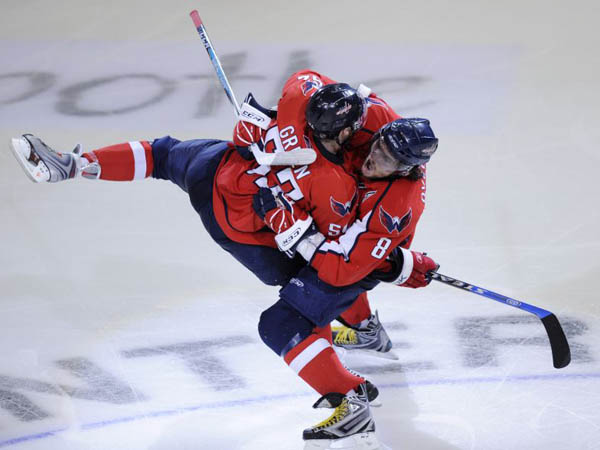
Mike Green’s 2007-08 season transcends trite descriptions like “breakthrough” and wades deeper into the infrequent waters of “revelation,” “grandiloquence,” or even the sincere “has that ever happened before?” Green, despite sporting a brutal faux-hawk and speaking in a soft and slow mumble to the point of listener distraction, played his first complete NHL season last year. By the way, he happened to lead NHL defenseman in goals while doing it. That’s an incredible feat. I think Bobby Orr led the league in defenseman goals in his first complete season, but I’m not sure anyone has done it since (I know some true greats like Paul Coffey and Brian Leetch, the two players from recent memory that remind me the most of Mike Green, did not do it).

Mike Green is probably the fastest defenseman in the league while carrying the puck. You know the guy in the beer leagues that leisurely picks up the puck from behind his own net and with a couple big strides moves up ice, head up, weaving in and out of opposing players like a pylon drill before closing in on the net and making one too many moves allowing the goalie to pull off a successful, though desperate, poke-check? That’s Mike Green. Except he’s doing it against NHL players. He combines ridiculous skating ability, I like to call him “crazy legs,” with some high-end puck-handling skills. He has an impressive toe-drag that he isn’t afraid to use on his side of the red line. All of this resulted in an 18-goal, 56-point campaign, several highlight end-to-end rushes (many of which resulted in nothing but open mouths), and the attention of the entire league. With the expiration of his entry-level deal and the ensuing threat of a massive restricted offer sheet this summer (how many teams can hope to draft and develop another Mike Green in the next 10 years?), Green was in line for a huge payday. He got it, to the tune of 4-years and $21-million. Let’s look at how Green compares to some of the other top defensemen in the NHL who have just completed their entry-level deals.


Phaneuf is the gold-standard among a pretty special group here. He has now produced three stellar NHL seasons, was recently nominated for the Norris Trophy, and was only a short while ago discussed in the same breath as Ovechkin and Crosby. Phaneuf had a pretty great season last year, playing a ton of minutes at evens and on both specialty teams. He put up a decent .95 ESP/60 but more than made up for it with an impressive power play scoring rate, 4.45 PPP/60. To put that in perspective, Nick Lidstrom recorded 4.47 PPP/60. Phaneuf also played significant minutes on the PK, and the Flames were better for it when he was on the ice. Phaneuf’s ES Relative Rating is .42, which is good but not great. He played decently tough minutes but with very good teammates (often Iginla and Langkow). Robyn Regehr, on the other hand, also had a Relative Rating of .42, but did so playing tougher comptetion (usually got more of the minutes against the other team’s top line) and with much weaker teammates. Regehr’s 5-year, $20M contract is an absolute steal.

Green’s offensive numbers, driven by his skating rather than a booming shot, are nevertheless pretty comparable to Phaneuf’s. He beat him with a fairly impressive 1.11 ESP/60, but came up well short with 3.28 PPP/60, which is only good for third among this group. This actually makes sense given that Green’s greatest asset, his wheels, is somewhat neutralized on the PP as it is more or less a half-court game. Green got very little PK time, a wise move with the way he clears the front of the net. Green paired with Morrison behind Ovechkin and Co., which explains his high Quality of Competition, higher Quality of Teammates, and ridiculously high CORSI number. Of the remaining four defenseman, none came close to touching Green’s ESP/60. Both Gilbert and Burns put up nice Relative Ratings (.50 and .93, respectively) and, not coincidentally, both of them saw significant time on the PK. Those two can both defend quite well (1.42 and .84). Burns also put up good scoring numbers: .90 at evens (good considering he’s playing for Jacques Lemaire) and 4.15 on the PP. Despite not scoring 18 goals like Green, he does have high-end offensive ability that he has matched with demonstrable defensive acumen. Had he not signed his extension at the beginning of the season and instead waited for July 1 like Green, it’s hard to imagine he wouldn’t have received a contract in the 5M range.

One thing that appears clear from this set of numbers is that teams pay a premium for offense. Tom Gilbert, though facing tougher competition and with worse teammates, still put up respectable ES points (.98). Though he only got 2nd pairing PP time, he still nearly matched Green in output (3.01 to 3.28). Instead, Gilbert played significant PK minutes and played them well (.84 Relative PK rating). He signed his contract only a few months before Green, but got much less money for a longer term ($4M for 6-years) and gave up three years of unrestricted free agency whereas Green gave up none.

I think Green’s contract is more or less appropriate given the market. The Caps clearly weren’t going to get an insane hometown discount like Regehr gave up (it can’t be that nice to live in Calgary, can it?), and so they did well to avoid a $6+M offer sheet, which I can only assume would have, and certainly should have, been coming. My only complaint is the term, four years is pretty short for a defenseman who’s just coming in to his own and who’s going to be a UFA now at the age of 26. Can you imagine what Mike Green is going to be worth on the open market then? What are teams that haven’t had anything resembling a dynamic blue line presence in years (Atlanta, Toronto, the Islanders) going to be willing to pay to sign a player like Green who can single-handedly get the puck going in the right direction?